
I’ve been developing a theological companion to the book—a kind of foundational operating system consisting of biblical, theological, and psychological concepts that undergird the larger project I’m currently writing, tentatively titled 10,000 Days of Sickness: A Christian Memoir and Survival Manual through Prolonged Suffering and the Impossible Constraints of the Abyss.
So, partly as an update—and partly as proof that I’m still alive—here’s Section 6.2 of that companion volume.
Please pray for me, that my first book will truly impact people that really need to read it.
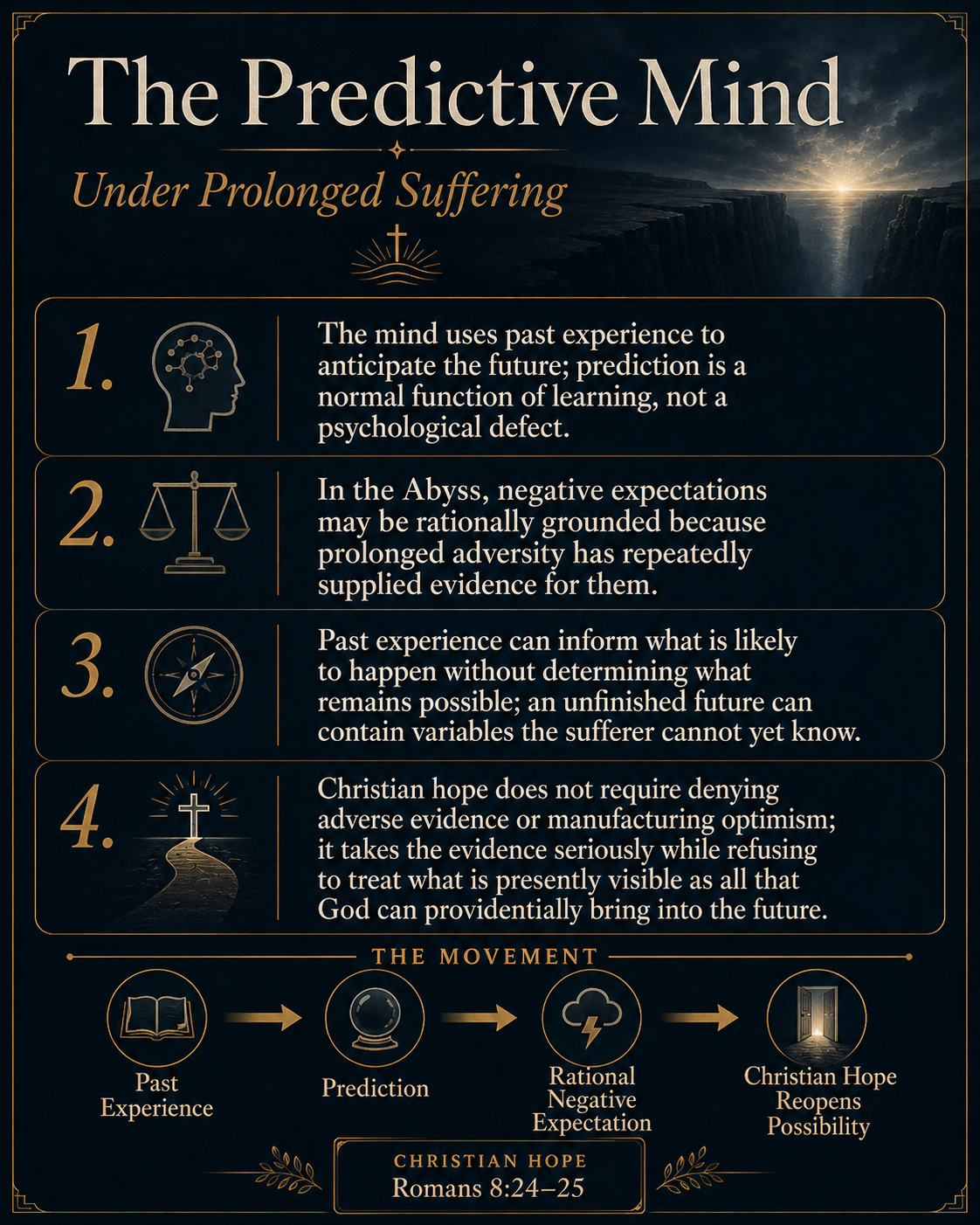
6.2 — The Predictive Mind Under Prolonged Threat
Governing Question
How does prolonged adversity shape what the mind expects from the future, and what happens when expectations formed from real experience begin governing how new possibilities are perceived?
Key Scriptures
Numbers 13:30–33 — Past and present danger shape Israel’s expectations of what is possible.
1 Samuel 27:1 — Repeated pursuit leads David to conclude that Saul will eventually kill him.
Psalm 42:5–11 — The distressed soul must speak hope back into its own expectations.
Psalm 77:7–12 — Present distress projects itself into questions about whether God’s favor has ended.
Lamentations 3:17–24 — Affliction constricts expectation until remembrance reopens hope.
Mark 5:25–29 — After twelve years of worsening illness and exhausted conventional remedies, the woman acts upon a radically new possibility.
Romans 4:18–21 — Abraham confronts visible evidence without allowing it to exhaust what remains possible with God.
I especially like 1 Samuel 27:1 for 6.2:
David thought to himself, “One of these days I will be destroyed by the hand of Saul.”
That’s almost a biblical example of the predictive mind in one sentence. David isn’t hallucinating danger. Saul really has been trying to kill him. The prediction has data behind it.
Psalm 77 is also excellent because distress begins extrapolating:
“Will the Lord reject forever? Will he never show his favor again?”
The present condition starts becoming a model of the future.
Canonical Concept
Human beings do not encounter the future as blank slates. The mind uses previous experience to anticipate what is likely to happen next. We learn which situations are safe, which actions produce results, which warning signs matter, and which outcomes tend to follow particular conditions. This capacity is essential to ordinary life. Prediction is one of the ways experience becomes useful. Research on expectation and threat learning broadly supports this basic picture: prior information and learned associations help organisms anticipate and respond to what is likely to happen next.
For someone living in the Abyss, however, the history from which those expectations are formed can become overwhelmingly negative. Treatments fail. Doors remain closed. Effort produces little change. Improvements prove temporary. Hoped-for turning points do not arrive. As 6.1 established, these experiences are not imaginary, and the lessons drawn from them should not automatically be dismissed as distorted. The predictive mind is working with the history it has actually been given.
Scripture portrays this movement from experience into expectation. After years of Saul’s pursuit, David thinks, “One of these days I will be destroyed by the hand of Saul” (1 Samuel 27:1). His expectation does not emerge from nowhere; Saul has repeatedly attempted to kill him. In Psalm 77, prolonged distress expands into questions about the future: “Will the Lord reject forever? Will he never show his favor again?” (vv. 7–8). Suffering does not remain confined to memory. It begins shaping expectation.
This marks the transition from 6.1. The sufferer is no longer responding only to what has happened. The mind carries accumulated experience forward and uses yesterday’s patterns to anticipate tomorrow. If effort has repeatedly failed, another attempt may be expected to fail. If improvement has repeatedly ended in relapse, improvement itself may be approached cautiously. If hope has repeatedly preceded disappointment, a new reason for hope may arrive already burdened by the memory of what happened before.
Past Experience → Learned Pattern → Future Expectation
There is nothing inherently defective about this process. A mind that ignored repeated experience would be incapable of learning from reality. Indeed, under prolonged adversity, negative expectations may be more rational than indiscriminate optimism. The problem is not that the sufferer uses the past to anticipate the future; the problem arises when the authority granted to the past begins exceeding what the past can actually establish.
The future is informed by history, but it is not identical to history. Circumstances change. New people enter. New technologies appear. Resources emerge. Human decisions alter causal pathways. Previously independent events converge. None of this requires the sufferer to pretend that the historical pattern is better than it is. It requires only the recognition that past experience is evidence about the future, not exhaustive knowledge of it.
Christian hope therefore does not require less rigorous engagement with reality. Abraham did not deny the apparent impossibility confronting him (Romans 4:19). Biblical hope does not ask the sufferer to falsify the evidence, manufacture optimism, or call an unlikely outcome likely. It asks the sufferer to remain faithful to what the evidence establishes without claiming that the evidence establishes more than it does.
This is the psychological and epistemological challenge of the predictive mind under prolonged threat. The sufferer must somehow hold two truths together: the past deserves to be taken seriously because it really happened, and the future must remain genuinely unfinished because it has not happened yet. The task is neither to forget the data nor to surrender the future to it.
Core Principles
- The mind uses past experience to anticipate the future; prediction is a normal function of learning, not a psychological defect.
- In the Abyss, negative expectations may be rationally grounded because prolonged adversity has repeatedly supplied evidence for them.
- Past experience can inform what is likely to happen without determining what remains possible; an unfinished future can contain variables the sufferer cannot yet know.
- Christian hope does not require denying adverse evidence or manufacturing optimism; it takes the evidence seriously while refusing to treat what is presently visible as all that God can providentially bring into the future.
Discovery 1 — When Probability Becomes Inevitability
The predictive mind does not become unreliable merely because it expects a negative outcome. In the Abyss, negative expectations may be well grounded. If nineteen treatments have failed, the sufferer has good reason to approach the twentieth cautiously. If repeated attempts to change a circumstance have produced the same result, expecting another failure may represent sound inference from available evidence rather than distorted thinking.
The danger is subtler. A conclusion about what has repeatedly happened can gradually become a conclusion about what will happen, and eventually about what can happen at all:
Repeated Failure → Low Probability of Change → Expected Failure → “No Other Outcome Is Possible”
These are different kinds of claims. “Every treatment I have tried has failed” describes the past. “The next treatment is unlikely to work” estimates probability. “The next treatment will fail” predicts an outcome. But “nothing can ever work” makes a claim about the boundaries of possibility itself. The evidence may strongly support the earlier statements without being sufficient to justify the last.
This matters especially in the Abyss because the sufferer’s analysis may be exceptionally sophisticated. Years of experience can produce detailed knowledge of why existing approaches fail, which variables matter, what risks are real, and which apparent solutions have already been exhausted. Yet that knowledge is necessarily richest in what has already happened and what is presently visible. The error need not lie in the analysis of what is known. It can arise when knowledge of known variables is mistaken for knowledge of all variables.
Family V gives this limitation theological depth. Providence includes secondary causes, human freedom, hidden preparation, timing, unexpected convergence, Divine Supply, and Redemptive Integration. None guarantees the particular earthly outcome the sufferer desires. But the future may contain people not yet met, decisions not yet made, discoveries not yet available, resources not yet supplied, and circumstances not yet converged. The variables visible today are not necessarily all the variables that will shape tomorrow.
Rigorous analysis can therefore honestly conclude, “Given everything I presently know, I cannot see a viable path.” Christian hope does not require denying that conclusion. It requires precision about its limits: “I cannot see a path” is not epistemologically equivalent to “there is no path.”
This is not an argument for optimism. Some outcomes genuinely are improbable. Some doors will remain closed. Some losses will never be reversed. The task is not to replace negative certainty with positive certainty, but to preserve distinctions the Abyss can gradually erase:
Unlikely ≠ Certain
Unseen ≠ Nonexistent
No Known Path ≠ No Possible Path
The past deserves its full evidential weight. It does not deserve the final word on what remains possible.
Discovery 2 — The Future Can Hurt Before It Happens
We ordinarily imagine suffering as moving forward through time: something happens, and we experience its consequences. But the predictive mind makes something stranger possible. An event that has not happened can begin imposing psychological costs in the present because the mind has learned to expect it.
Past Threat → Predicted Future Threat → Present Psychological and Physiological Response
Most people have experienced a mild version of this with an injection. Imagine being told, “You will receive a painful injection at exactly 3:00 p.m.” You may dread it and tense as the hour approaches. But the threat has a boundary. The injection comes, the needle leaves, and the anticipation ends.
Now imagine being told, “At some point during the next several days, you will unexpectedly receive the same painful injection. We cannot tell you when.” The injection itself has not become more painful. What has expanded is its psychological footprint. Every hour can now contain the injection because the mind is waiting for the threat.
Psychological research gives this thought experiment greater depth. In a study of 99 adults, participants anticipated aversive stimuli under conditions where the timing was either certain or uncertain. When they knew something aversive was coming but could not predict precisely when, they reported greater fear and anxiety and showed greater physiological arousal, measured through skin conductance.[1] The psychological burden of a threat is therefore shaped not only by its severity, but by how much time its anticipated shadow occupies.
The Abyss can resemble the second injection, except the sufferer has not been promised there will be only one. They may not know when the next relapse, failed treatment, financial blow, closed door, or collapse of an apparent improvement will come. History has simply taught them to expect another blow. The threat therefore begins occupying the spaces between the threats.
Repeated Threat + Uncertain Timing + Learned Expectation → Expanding Psychological Footprint
A relapse may last three days while anticipation of the next relapse occupies six months. Bad news may arrive during a five-minute conversation while its expected arrival has occupied hundreds of hours. The actual blow occurs once; the predictive mind can rehearse its arrival hundreds of times.
Pain research makes this more than a metaphor. Brain-imaging research has distinguished the neural activity associated with pain itself from activity associated with anticipating pain; anticipation can itself produce changes in mood and behavior that add to suffering.[2] Research on the related “nocebo effect”—in which negative expectations can intensify subsequently experienced pain or other symptoms—goes further. Negative expectations formed through suggestion and previous learning can measurably intensify subsequent experiences of pain and itch. A systematic review and meta-analysis found meaningful learned nocebo effects across experimental studies.[3] Prediction can therefore do more than make us suffer before the event; under some conditions, what has been learned and expected can influence how the suffering experienced when the event actually occurs.
Prolonged adversity can therefore become psychologically larger than the sum of its individual events. The sufferer may simultaneously carry:
Remembered Suffering + Present Suffering + Anticipated Suffering
Past, present, and future become psychologically compressed. The sufferer may be living through one adversity while remembering ten previous versions of it and rehearsing the eleventh. A painful event has both a chronological duration and a psychological footprint. The two need not be the same size.
The effect becomes especially striking when the predicted event never occurs. The medical result is better than expected. The improvement holds. The feared conversation goes differently. Yet the anticipatory distress was real. The predicted future never arrived, but some of its suffering did. The Abyss can extract psychological payment for events that reality never ultimately charges.
This does not mean the sufferer was foolish to anticipate them. Their history may have made the prediction reasonable. But there is an important difference between preparing for a possible future and psychologically inhabiting it before it arrives. Preparation responds to risk. Psychological inhabitation begins paying the emotional cost of an outcome before the evidence has settled whether it will occur.
This is why uncertainty, uncomfortable as it is, sometimes deserves to be protected rather than prematurely resolved. “This may happen” also means “this may not happen.” The predictive mind wants to reduce uncertainty so it can prepare. But when a feared possibility becomes a psychologically experienced future, tomorrow’s suffering can begin colonizing today.
There is, however, a remarkable Christian inversion. If anticipated threat can cast its shadow backward into the present, anticipated redemption can cast its light backward too. Paul places present suffering beside “the glory that will be revealed in us” (Romans 8:18), while Jesus endured the cross “for the joy set before him” (Hebrews 12:2). The future did not make present suffering unreal; it changed what could be carried within it.
Anticipated Threat → Present Fear / Distress
Anticipated Redemption → Present Hope / Peace / Endurance
This must not become positive thinking dressed in Christian language. We cannot know that a particular illness will disappear, relationship will be restored, or earthly door will open. The believer cannot simply replace a feared future with a preferred future and call it faith. But Christian hope contains future realities grounded not in personal prediction but in God’s character, presence, promises, and ultimate redemption. The future therefore need not be populated only by what painful history has taught the sufferer to fear.
Perhaps this is why hope can matter before circumstances change. It does not need to reveal exactly what will happen next. Sometimes it merely prevents anticipated threat from possessing the whole future. A glimpse of redemption can send something backward into the present—a little peace, another day’s endurance, enough openness to keep searching, enough possibility to keep tomorrow’s feared suffering from completely occupying today.
The predictive mind means that human beings partly inhabit the futures they expect. In the Abyss, this can enlarge suffering far beyond the moments in which adversity actually occurs. But the future does not cast only shadows. In Christ, it can cast light backward too.
Discovery 3 — The Abyss Can First Imprison Us To Double Down Inside an Understanding of Reality—and Then, Paradoxically, Force Us to Abandon It
The relationship between suffering and psychological rigidity is not linear. The same Abyss can produce two opposite responses at different stages of its intensity. Initially, increasing pressure can make the sufferer grip their existing understanding of reality more tightly. But if the pressure becomes sufficiently severe and prolonged, there can come a point where maintaining that understanding becomes psychologically unbearable. What the Abyss first entrenched, the Abyss can eventually help break open.
The mechanism therefore has two distinct phases:
Phase I — Entrenchment:
Pressure → Greater Need for Control → Tighter Grip → Narrower Vision
Phase II — Breaking Open:
Critical Mass → Surrender of Certainty → Childlike Openness → Reconstruction
Phase I — The Abyss Makes Us Grip Reality More Tightly
Human beings do not easily surrender the understandings that help them survive. When life becomes dangerous, we naturally try to make it intelligible: identify the threat, understand its causes, predict what comes next, and determine what might still work. In the Abyss, our understanding of reality becomes more than an intellectual framework; it becomes a survival mechanism.
This can become particularly pressurizing for the analytical sufferer who has spent too long confronting an apparently insoluble problem. The engineer models. The scientist searches for causes. The strategist generates alternatives. When one explanation fails, they revise it. When one route closes, they search for another. Failure does not initially make such people abandon their way of understanding reality. It makes them brace harder.
But what happens when a stoppable force meets a seemingly immovable object? The analytical sufferer keeps applying force because that is how difficult problems have always been solved: analyze, adjust, and push again. But unlike the proverbial unstoppable force, a human being is finite. If the object will not move, eventually something must give.
Initially, however, the response is usually to push harder. The worse the Abyss becomes, the greater the perceived need to understand it—to find a long-term solution or, failing that, some deeper meaning capable of making it bearable. Another symptom produces more investigation. Another failed treatment produces another hypothesis. Another closed door produces another strategy. The sufferer plants all ten toes down and tries again because understanding promises some recovery of control over an increasingly uncontrollable world.
Failure → More Analysis → Revised Understanding → Another Attempt → Further Failure → Tighter Grip
There is nothing inherently irrational about this. Much of it is exactly how difficult problems are normally solved. But the Abyss is not necessarily an ordinary problem. There may be variables the sufferer cannot control, information they cannot yet possess, people they have not met, developments that have not yet occurred, or providential possibilities no analysis could presently derive.
Meanwhile, survival itself narrows vision. The next symptom, treatment, bill, threat, or attempt becomes urgent. Larger questions about calling, possibility, beauty, service, and distant futures retreat from view. Like someone fighting for air, the sufferer becomes intensely attentive to what is immediately necessary for survival. That narrowing can be adaptive while simultaneously making the world appear smaller than it is.
The analytical sufferer can therefore experience a peculiar paradox:
Their understanding of the prison becomes increasingly sophisticated while their imagination of the world beyond it becomes increasingly diminished.
And the longer this persists, the stakes become greater than solving the original problem. If the world beyond the prison continues shrinking—and especially if that shrinking begins to feel permanent—physical or circumstantial suffering can deepen into existential suffering. The person is no longer asking only, How do I stop this pain? They begin confronting larger questions: Is this all my life will ever contain? What is all this for? Is there still a future large enough to justify enduring the present?
Viktor Frankl argued that human beings can endure extraordinary hardship when suffering remains connected to meaning or purpose, drawing upon Nietzsche’s formulation that one who has a why to live for can bear almost any how. The Abyss becomes especially dangerous when it attacks both at once: it makes the “how” increasingly unbearable while progressively obscuring the “why” that made bearing it possible.
Unsolved Adversity → Survival Focus → Narrowing World → Diminishing Future → Erosion of Meaning → Existential Suffering
Yet increasing existential pressure does not necessarily make the sufferer more open. Initially, it can make them grip their existing understanding even harder. This is where confirmation bias can reinforce the process. Each additional failure fits increasingly easily inside the survival architecture already constructed: Of course that treatment failed. Of course the improvement disappeared. Of course that door closed. The existing understanding becomes increasingly effective at explaining the Abyss—and increasingly difficult to surrender.
But maintaining that architecture carries a psychological cost. Every new failure must be incorporated. Every threat anticipated. Every contradiction explained. Another strategy must somehow be found. The more uncontrollable reality becomes, the more desperately the mind may attempt to recover control through understanding.
Eventually a profound existential tension can emerge:
The sufferer understands the prison better and better, yet that understanding still cannot provide escape, sufficient control, or enough meaning to make the prison bearable.
The stoppable force keeps pushing. The seemingly immovable object remains.
And eventually, something must give.
That is where the second phase begins.
Phase II — At Critical Mass, the Abyss Can Force a Surrender of What was Naturally Entrenched
There can come a point where the sufferer has analyzed more, tried more, learned more, consulted more people, and revised more strategies—and still cannot escape. Another adjustment no longer restores control. Another explanation no longer makes the world cohere.
At some critical mass of suffering, the psychological cost of maintaining the understanding of reality—and the methods of confronting it—that helped the sufferer survive can become greater than the perceived cost of surrendering them.
The person does not necessarily conclude that everything they learned was false. Much of it may remain painfully accurate. What they surrender is something subtler: the conviction that what they already know is sufficient to determine what reality contains, how reality must work, or what kind of solution remains possible.
That surrender can be especially difficult when possibilities outside the existing framework carry threatening implications of their own. What if the solution requires not merely a different strategy, but a change in goals, identity, relationships, vocation, expectations, or even the life the sufferer has spent years trying to recover? A different future may require leaving home, relinquishing an old career, ending a toxic relationship that still provides comfort, or reconsidering beliefs upon which we have built our lives. Sometimes we resist a larger reality because entering it may require surrendering something in the smaller one.
Behind all this lies an even more unsettling recognition: there are consequential variables in reality that we cannot presently see, understand, or control. They may have shaped years of suffering, closed doors, unexpected outcomes, and apparently impossible constraints. The analytical mind that has spent years trying to contain the Abyss within an intelligible system finally confronts what it has resisted from the beginning:
Reality has been unfair. Reality has been painful. And reality is still larger than my ability to master it.
Here lies an existential fork.
One possibility is to continue insisting that reality must finally answer to the self—that if suffering cannot be solved, explained, controlled, or given sufficient meaning, then existence itself becomes increasingly intolerable. The demand for mastery can survive even after mastery has become impossible.
Indeed, the sufferer may double down precisely because continued striving still provides something the Abyss has taken almost everywhere else: fleeting experiences of agency that validate the threatened ego. I am still fighting. I am still choosing. I am still doing something. Even when results diminish, effort itself can become evidence of self-determination. The fight begins supplying some of the meaning that victory once supplied.
But this creates another trap:
Loss of Control → Greater Effort → Experience of Agency → Temporary Appeasement of the Fallen Ego → Diminishing Results → Greater Need to Keep Trying
Exerting control can temporarily soothe the deeper terror of admitting that consequential parts of reality lie beyond our control. For a moment, effort restores the feeling of being an active force rather than merely the object of forces acting upon us. But because the underlying constraint remains, the relief cannot last. The failure of control generates the felt need for still more control.
What began as problem-solving can therefore become existential. To stop pushing can feel like surrendering not merely the strategy, but the self that survived by pushing. The result can be bitterness, despair, exhaustion, psychic fragmentation, or an increasingly desperate attempt to find some remaining domain of reality that can still be controlled.
Here the distinction between agency and sovereignty becomes crucial. Faithful agency acts vigorously upon what can actually be influenced while entrusting to God the variables and outcomes that cannot. Attempted sovereignty cannot tolerate that remainder. It responds to uncontrollable variables with still more effort, analysis, vigilance, or control—as though sufficient exertion could eventually eliminate uncertainty. The sufferer assumes responsibility not merely for what they can faithfully do, but for securing outcomes they were never capable of guaranteeing.
There is an even deeper question: What is the striving ultimately for? Self-centered striving asks work, achievement, recovery, recognition, or even victory over the Abyss to establish the self—to prove its worth, secure its identity, or justify its existence. The Abyss exposes the fragility of this arrangement. When the outcome upon which meaning depends remains unreachable, the meaning built around achieving it begins to collapse as well.
God-centered striving is differently anchored. The Christian still works, searches, builds, analyzes, persists, and seeks deliverance—but these become acts of participation with Christ rather than projects of self-justification. Their meaning no longer depends entirely upon whether the immediate problem yields. Faithfulness can remain meaningful before victory; love can remain fruitful before circumstances change; obedience can participate in purposes larger than the sufferer can presently see.
Self-Centered Striving → Outcome Becomes Identity → Failure Threatens Meaning → Greater Striving → Deeper Collapse
God-Centered Striving → Participation with Christ → Divine Supply → Meaning Beyond Immediate Outcome → Faithfulness That Can Outlast the Abyss
This is why surrender of mastery does not mean passivity. The Christian may continue striving just as intensely, but the source, purpose, and burden of that striving have changed. The self no longer has to manufacture meaning, guarantee the outcome, or carry the future alone. Effort becomes participation rather than sovereignty, drawing upon Divine Supply and purposes larger than the Abyss itself.
The alternative to attempted sovereignty is therefore not giving up. It is:
Surrender the demand for mastery itself.
But that surrender raises the deepest question of all: if the self cannot master reality, what—or who—can be trusted with what the self cannot know, control, or carry?
For the Christian, the answer is not abstraction, fate, or resignation.
It is God Himself.
The variables mysterious to us are not mysterious to Him. The One whose wisdom exceeds the variables we cannot see. The One whose love means that surrender need not be surrender into indifference. And the One who “has made everything beautiful in its time” (Eccl. 3:11).
This is not:
Suffering → Stupidity
It can be almost the reverse:
Accumulated Knowledge → Increasing Certainty → Increasing Rigidity → Unbearable Contradiction → Surrender of Certainty → Childlike Openness
There can be something almost born-again-like about this moment—not because psychological surrender is conversion, but because its structure resembles starting again. The sophisticated adult, carrying years of knowledge, explanations, strategies, and assumptions seared into them by experience, finally reaches a point where they can say:
I don’t know anymore. Show me.
The engineer does not stop being an engineer. The analytical mind does not abandon evidence. It relinquishes the demand that reality must fit inside what it presently understands. The mysterious variables remain mysterious, but the sufferer no longer carries the impossible burden of being their sovereign.
For the Christian, this surrender has an object. We surrender what we cannot know and cannot control to the Logos—the One through whom reality itself was made. We do not cease searching, thinking, testing, or acting. We surrender the assumption that our present understanding defines the boundaries of what is real or possible.
And that can reopen possibility.
This progression may be especially recognizable to the self-made person. A lifetime of achievement can teach a powerful lesson: problems yield to sufficient intelligence, discipline, creativity, and persistence. Usually, that lesson is substantially true. Obstacles are overcome, careers are built, skills are acquired, and difficult circumstances improve because someone refused to stop pushing.
The Abyss can therefore produce an unusual irony. The qualities that made surrender unnecessary in ordinary life can make surrender extraordinarily difficult in prolonged crisis. The self-made person does what experience has trained them to do: tries harder, learns more, consults more widely, changes strategy, and tries again. Past success itself becomes evidence for doubling down.
Problem → Effort → Failure → Greater Effort → Better Strategy → Further Failure → Exhaustion of Self-Sufficiency → Surrender → Radical Openness
Surrender therefore need not arise because the person was weak. Sometimes it comes only after formidable strength has finally discovered its limits. Discomfort often traces those limits long before we are willing to acknowledge them, revealing the boundary between what we can presently carry and what lies beyond our capacity to master.
And Scripture gives us an extraordinary picture of what can happen when that boundary is reached.
Mark 5 — From Entrenchment to Radical Openness
The woman with the bleeding in Mark 5 provides an extraordinary biblical picture of both phases.
For twelve years, she had suffered from chronic bleeding. Conventionally, she did what a reasonable sufferer would do: she sought doctors. Mark tells us that she “had suffered a great deal under the care of many doctors and had spent all she had,” yet instead of improving, she grew worse (Mark 5:26).
Notice the trajectory. Her failed treatments apparently did not immediately drive her outside conventional medicine. Mark gives us “many doctors,” great suffering under their care, the expenditure of everything she possessed—and deterioration rather than recovery.
We cannot know her internal psychology because Mark does not tell us. But the narrative pattern resembles Phase I remarkably well:
Worsening Condition → Greater Need for a Solution → More Doctors → More Treatment → More Resources Expended → Still Worse
The Abyss did not initially free her from the conventional solution-space. If anything, the narrative shows how thoroughly she exhausted it.
Until Mark gives us the devastating phrase:
“She had spent all she had.”
The known pathway had reached its limit.
And her predicament was not merely medical. Under Leviticus 15:25–27, prolonged bleeding carried ritual-impurity consequences. Her condition therefore existed within an established religious world as well: categories of cleanliness and uncleanliness, contact, exclusion, and eventual restoration.
Then something extraordinary happens.
She hears about Jesus.
“When she heard about Jesus, she came up behind him in the crowd and touched his cloak, because she thought, ‘If I just touch his clothes, I will be healed.’” (Mark 5:27–28)
Where did that idea come from?
Mark never tells us.
No doctor prescribed it. No priest instructed her to do it. No established medical pathway pointed toward it. No prescribed ritual for her condition required it.
And the conviction itself is extraordinary. She does not even ask Jesus to heal her. She does not present her medical history. She does not request prayer. She does not ask Him to lay hands upon her.
She “simply” thinks:
“If I just touch his clothes…”
And then:
She reaches.
After twelve years inside an apparently insoluble problem, she acts upon a possibility that neither her medical experience nor the established religious categories surrounding her condition could have generated in any obvious way.
Nobody told her to reach.
We must not impose a psychology Mark does not give us. We cannot know whether twelve years of failed treatment psychologically caused this radical openness. But as a biblical picture, the movement is extraordinary:
Conventional Solutions → Increasing Desperation → Everything Spent → Existing Pathway Exhausted → Radical Openness → Previously Unthinkable Action → Christ
And this is where Mark 5 becomes more than an illustration of thinking outside the box.
The lesson is emphatically not that desperation makes unconventional ideas true, that expertise should be distrusted, or that sufficiently radical thinking produces miracles. The woman was not healed because she “freed her mind.”
She was healed because Christ was there.
Yet her story gives us a remarkable picture of what can happen when the known world has been exhausted. The very survival architecture that tightens under prolonged suffering can finally loosen. The hand that has spent years gripping what it knows opens—and becomes capable of reaching toward what it could not previously have derived from what it knew.
And that creates the possibility of reconstruction.
For the Christian, reconstruction does not mean replacing one rigid worldview with arbitrary possibilities. It means rebuilding our understanding of reality around Christ while retaining everything true that suffering has taught us. Evidence remains evidence. Expertise remains valuable. Reason remains indispensable. But none of them is permitted to define exhaustively what God can still do.
The two phases therefore complete themselves:
PHASE I — ENTRENCHMENT
Pressure → Tighter Grip → Narrower Vision
↓ CRITICAL MASS ↓
PHASE II — BREAKING OPEN
Surrender → Childlike Openness → Reconstruction in Christ
The Abyss can first make us grip reality harder because gripping helped us survive. Yet sometimes, at sufficient depth, survival itself requires opening the hand.
The sufferer finally says:
I don’t know. Show me.
And for the Christian, that surrender does not open onto nothingness. It opens toward Christ.
The woman could never have derived the manner of her deliverance from the history that preceded it. Twelve years of experience could tell her what had failed. They could not tell her everything that remained possible.
She opened her hand.
She reached.
And Christ was there.
Concluding Reflection
The predictive mind is not the enemy. It remembers what hurt, detects patterns, anticipates danger, and helps us survive. After prolonged adversity, many of its darker expectations have not been invented; they have been learned. The sufferer does not need to become naïve in order to recover hope.
But prediction has limits. The past can tell us what has happened repeatedly and what we should reasonably prepare for. It cannot tell us everything the future will contain. Conditions change. People change. Doors appear that did not previously exist. And for the Christian, providence introduces possibilities that no extrapolation from present circumstances could fully anticipate.
The past deserves its full evidential weight. But what has repeatedly happened does not exhaust what can still happen.
We therefore continue to learn, prepare, seek help, test possibilities, and act upon what can genuinely be influenced. But we need not suffer every feared future before it arrives, nor demand that our analysis master variables no human being can control. Faith does not ask us to think less. It teaches us where the limits of our thinking lie—and whom to trust beyond them.
This requires neither forgetting what suffering taught us nor pretending the danger was never real. It requires something more difficult: holding what we know without allowing it to define exhaustively what remains possible.
That is perhaps the posture toward the future that prolonged sufferers most need: neither optimism nor despair, neither naïveté nor fatalism, but epistemic humility joined to Christian hope.
We can say:
This is what I know. This is what I fear. This is what experience has taught me to expect. But this is not all that reality may contain.
The predictive mind looks backward in order to anticipate what comes next. Faith does not ask it to forget what it has learned.
It simply refuses to let the past have the final word about a future that still belongs to God.
[1] Hur J, Smith JF, DeYoung KA, Anderson AS, Kuang J, Kim HC, Tillman RM, Kuhn M, Fox AS, Shackman AJ. Anxiety and the Neurobiology of Temporally Uncertain Threat Anticipation. J Neurosci. 2020 Oct 7;40(41):7949-7964. doi: 10.1523/JNEUROSCI.0704-20.2020. Epub 2020 Sep 21. PMID: 32958570; PMCID: PMC7548695.
[2] Ploghaus A, Tracey I, Gati JS, Clare S, Menon RS, Matthews PM, Rawlins JN. Dissociating pain from its anticipation in the human brain. Science. 1999 Jun 18;284(5422):1979-81. doi: 10.1126/science.284.5422.1979. PMID: 10373114.
[3] Thomaidou MA, Blythe JS, Peerdeman KJ, van Laarhoven AIM, Van Schothorst MME, Veldhuijzen DS, Evers AWM. Learned Nocebo Effects on Cutaneous Sensations of Pain and Itch: A Systematic Review and Meta-analysis of Experimental Behavioral Studies on Healthy Humans. Psychosom Med. 2023 May 1;85(4):308-321. doi: 10.1097/PSY.0000000000001194. Epub 2023 Mar 23. PMID: 36961347; PMCID: PMC10171297.


Love whatever you are writing bro. Will pray for its completion. Does not matter what you are writing in the end, here’s my pre-order!
With Best Regards
Joshua Fong , CFA
Social: https://linktr.ee/JoshuaFong
This e-mail is private and confidential and intended only for the eyes of the addressee. Please delete if you are not the addressee.
The materials and information in this e-mail or sent under its cover are provided purely for the purpose of general information only and should not be construed or regarded as solicitation to invest or trade. It is also not to be regarded as financial, investment or other advice or recommendation. While we have made reasonable efforts to ensure the accuracy of such information and materials, we accept no responsibility or liability for the content or accuracy of such information or materials and you are advised to conduct your own checks and verifications and to seek professional financial, investment or other advice as appropriate, or if you have any doubts or queries.
LikeLike